|
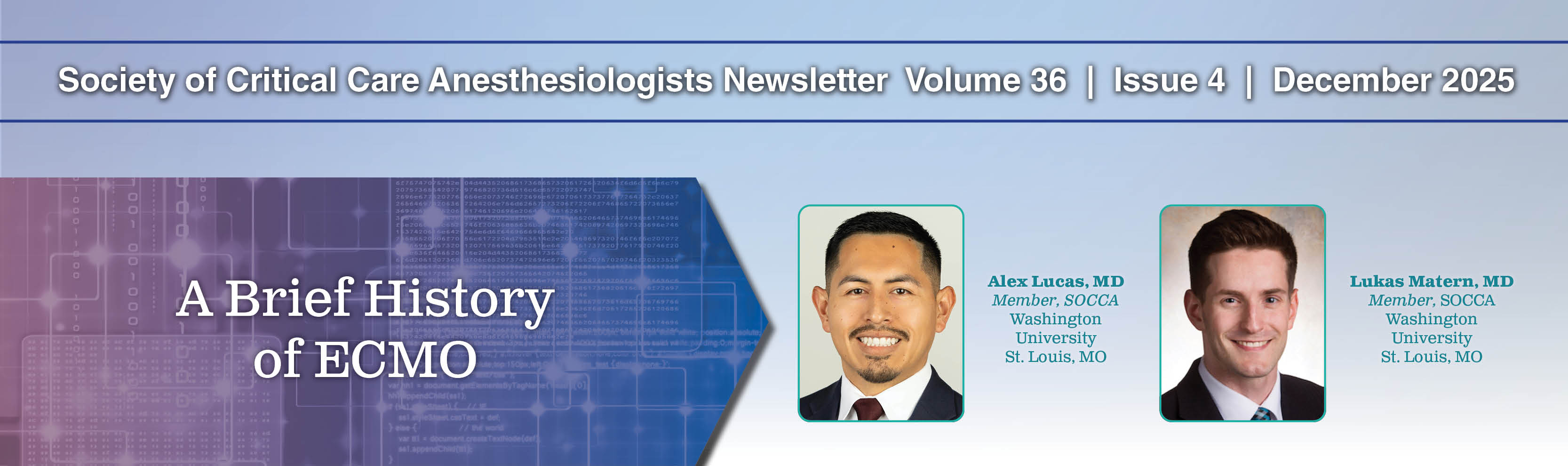
A Brief History of ECMOby Alex Lucas, MD Volume 36 | Issue 4 | Dec 2025
Extracorporeal membrane oxygenation (ECMO) represents the highest level of support for cardiopulmonary failure refractory to conventional treatment. Although first successfully introduced in the late 20th century, the concept of extracorporeal support dates back to the dawn of medicine. Here, we outline notable—but certainly not all—highlights in the development of this life-saving technology. In the second century C.E., the Greco-Roman physician Galen proposed that blood was carried in two distinct systems terminating separately in the arteries and veins. This belief persisted through the centuries until 1628, when Dr. William Harvey published an article describing that blood is pumped through arteries and veins to form a continuous circuit.2 The scientist Robert Hooke later theorized that simply exposing blood to fresh air—without passage through the lungs—might sustain life.3 These ideas laid the theoretical foundation for artificial circulation and gas exchange. During the 19th century, experiments sought to translate theory into practice. In 1849, physiologist Julien Jean Cesar Le Gallois unsuccessfully attempted to perfuse decapitated rabbits by injecting arterial blood, though he was later able to perfuse an isolated kidney. By 1865, a roller pump enabled the continuous movement of blood through artificial circuits. The first oxygenator was later developed in 1882 by W. von Schröder of Strasburg, who bubbled air through venous blood in a reservoir system. These early oxygenators were plagued by challenges related to foaming until a rotating film oxygenator was developed by Max von Frey and Max Gruber in 1885.4 Their oxygenator provided continuous flow in a closed system. Heating chambers, valves, and syringe pumps were then incorporated to approximate physiologic conditions. The isolation and subsequent clinical use of heparin in the 1930s further proved essential to making cardiopulmonary bypass (CPB) technology a reality.4 Extracorporeal support underwent further rapid development into the 20th century. Dr. John Gibbon, motivated by the death of a young woman from a pulmonary embolism, worked for decades to optimize a film oxygenator. His team later performed the first successful procedure involving CPB in 1953 for closure of an ASD.5 Membrane oxygenators were soon introduced to address the complications associated with direct blood-air contact. In 1963, Dr. Theodor Kolobow developed a silicone spiral coil membrane oxygenator, allowing prolonged CPB use.6 These systems eventually evolved into the hollow fiber membranes that are still used today. In 1971, Dr. J. Donald Hill supported a trauma patient who developed ARDS for 75 hours on ECMO—the first veno-venous (V-V) ECMO patient to survive.7 In the same year, Dr. Robert Bartlett and Dr. Alan Gazzaniga continued to investigate the use of silicone membrane oxygenators for veno-arterial (V-A) applications in children. The two successfully placed a patient in cardiogenic shock following a Mustard procedure on V-A bypass who went on to recover. More success stories followed, notably the rescue of “Esperanza,” a neonate in respiratory failure due to meconium aspiration and persistent fetal circulation in 1975. Soon, over 40 infants had been treated with ECMO.9 Similarly, CPB became firmly established, expanding the field of cardiac surgery. Dr. Bartlett remained a leading advocate for extracorporeal technology and founded the Extracorporeal Life Support Organization (ELSO) in 1989. Widely known as the “Father of ECMO,” he inspired generations to expand ECMO technology and clinical applications.10 Today, ELSO remains the premier organization for advancing the use of ECMO, maintaining a global registry, and promoting education worldwide. As ECMO became a viable technology, efforts shifted toward establishing evidence through clinical trials. One of the first rigorous trials, conducted in 1979 by Dr. Warren Zapol and colleagues, examined ECMO in severe acute respiratory failure. Despite its landmark status, the trial showed no survival benefit compared to conventional management and dampened ECMO enthusiasm for decades. However, the paper was upheld as a foundational ECMO trial and highlighted opportunities for further study.11 Only with the publication of the CESAR trial in 2009 was a mortality benefit found, namely when patients with severe ARDS were transferred to an ECMO-capable center.12 Although not without criticisms, the study is credited with reviving considerable interest in ECMO. In 2018, the multicenter EOLIA trial compared V-V ECMO to conventional management in ARDS. This study showed no significant mortality benefit but provided evidence of ECMO’s safety and potential advantages when initiated early.13 More recent studies have evaluated the role of V-A ECMO for the management of cardiac arrest, giving rise to the concept of extracorporeal cardiopulmonary resuscitation (ECPR). The 2020 ARREST trial studied V-A ECMO for out-of-hospital cardiac arrest with refractory shockable rhythms.14 This study showed an improved survival to hospital discharge for the group placed on V-A ECMO. Today, a growing number of centers are utilizing ECPR. Today, ECMO is used in more than 50 countries, with over 250,000 cases now recorded in the ELSO registry.15,16 Patients are cannulated for ECMO in emergency departments, mobile ECMO units, and even at remote sites of cardiac arrest. New technology is expanding the cohort of survivors to patients once deemed unsalvageable. While much of the evidence around the use of ECMO remains equivocal—and research is complicated by patient, setting, and protocol heterogeneity—it is increasingly clear that ECMO may benefit carefully selected patients with refractory cardiopulmonary failure. The development of ECMO represents a remarkable achievement in medicine and promises to further enhance the care of critically ill patients worldwide. References
|