|
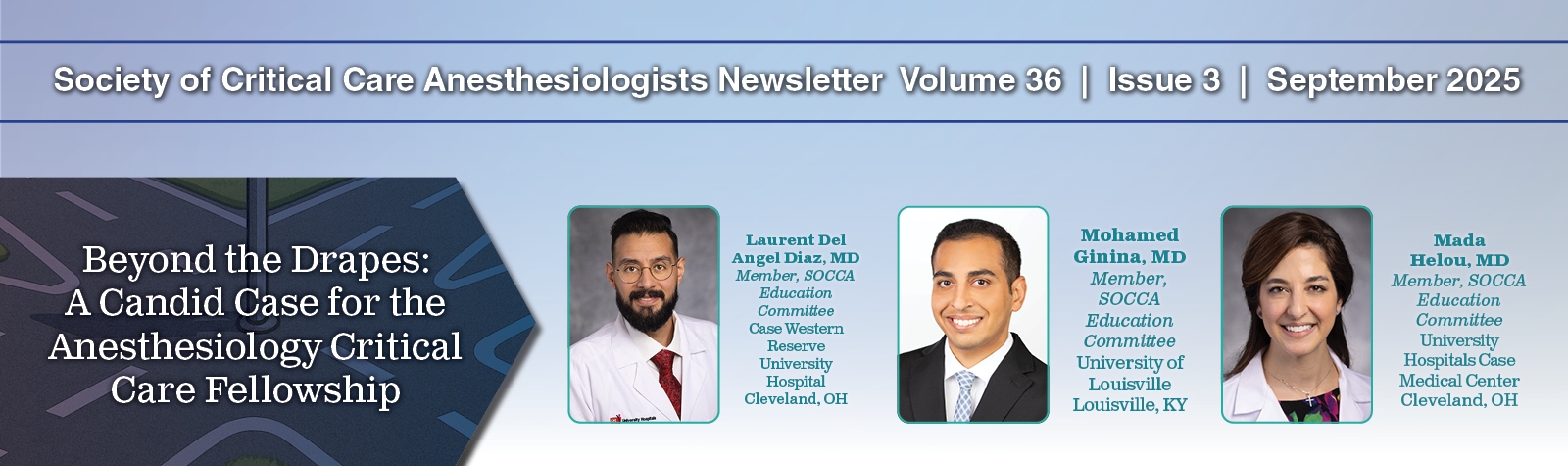
Beyond the Drapes: A Candid Case for the Anesthesiology Critical Care Fellowshipby Laurent Del Angel Diaz, MD; Mohamed Ginina, MD; Mada Helou, MD
Introduction
Anesthesiology is a dynamic and evolving specialty offering an exciting landscape of opportunities. With a strong job market and growing recognition of anesthesiologists’ broad skill set, it’s reasonable to question the need for additional training—especially in critical care. While fellowships in this area have historically faced recruitment challenges (1), a closer look reveals that anesthesiology critical care is not a detour, but a powerful accelerator. It unlocks advanced clinical mastery, leadership, and a deeper connection to the “why” behind our profession.
Reframing the Challenges
Common deterrents to fellowship—such as delaying an attending salary or concerns about ICU intensity—are valid but incomplete. That extra year of training is an investment in confidence, competence, and career flexibility. The ICU may be demanding, but it’s also where the most rewarding work happens. And while optional, critical care fellowship is a transformative opportunity for those drawn to high-acuity medicine and leadership.
Expanding Your Skill Set
As modern medicine advances, older and more complex patients increasingly require surgical care. According to CDC data, U.S. life expectancy continues to rise, along with surgical interventions in patients over age 65 (2,3). Anesthesiologists are central to managing perioperative risk in these high-stakes cases. Fellowship training sharpens your ability to handle instability, anticipate complications, and lead rapid interventions. You gain hands-on experience with life-saving technologies like ECMO, Impella, and LVADs—skills that demand high-level expertise (4–6).
Leadership in Action
Critical care is systems-level medicine. The ICU is where multidisciplinary collaboration reaches its peak. As an anesthesiologist-intensivist, you lead interprofessional teams, coordinate care plans, and guide families through difficult decisions. The Society of Critical Care Medicine emphasizes the importance of team leadership, communication, and situational awareness (7,8). These skills are essential not only for patient care but also for clinician resilience and effective leadership (9).
Broader Career Options
Dual training in anesthesiology and critical care opens doors in clinical practice, education, research, and administration. It enhances job security, especially in an evolving healthcare landscape marked by shifting Medicaid reimbursement and the expanding role of midlevel providers (10–12). Fellowship positions you for leadership in perioperative medicine, quality improvement, and academic growth. Institutions value the flexibility and depth that dual-trained physicians bring.
Hidden Perks: Autonomy and Flexibility
One lesser-known benefit of ICU work is schedule autonomy. Unlike the OR, ICU workflows are not surgeon-dependent. Many intensivist roles offer block schedules like 7-on/7-off, providing generous and predictable time off. These blocks allow for travel, family time, academic pursuits, or moonlighting. Dual certification also enables moonlighting in both ICU and OR settings, expanding clinical and financial flexibility.
The Human Connection
Critical care allows for deeper, more sustained relationships with patients and their families. These moments—often during life’s most vulnerable periods—can be profoundly meaningful. Unlike the episodic nature of intraoperative care, ICU work reconnects many physicians with the core values that drew them to medicine in the first place.
A Personal Reflection
During residency, even at a quaternary center with strong support, I questioned whether I was fully prepared for independent practice. Despite excellent training, I felt a strong drive to go further—to understand the mechanisms behind complications, care for patients across the perioperative continuum, and play a pivotal role in their recovery. The ICU offered the challenge, purpose, and growth I was seeking. (a reflection from author Dr. Del Angel Diaz)
Conclusion
Critical care isn’t for everyone—and that’s okay. But for those drawn to complexity, acuity, leadership, and impact, it’s a path worth serious consideration. It strengthens your clinical foundation, protects against workforce uncertainty, and realigns you with the purpose of our profession. For many of us, fellowship was not a year lost—it was the piece that completed our career vision.
References
AuthorsLaurent Del Angel Diaz, MD Mohamed Ginina, MD
Mada Helou, MD
|