|
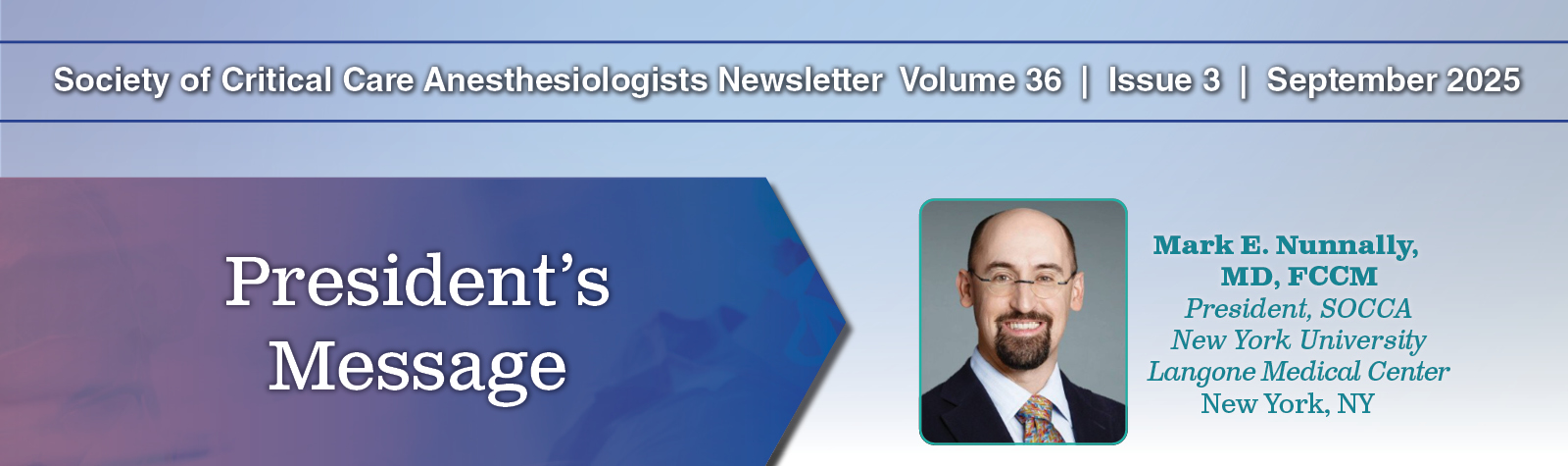
President’s Messageby Mark E. Nunnally, MD, FCCM
Our themed issue, “Opportunities in Critical Care” is a timely one, and something deeply personal for me. Perhaps never has Anesthesiology been such a target-rich environment. It’s a sellers’ market and it seems that everyone is hiring. As the subspecialty that extends our abilities to more venues than any other in the profession, this phenomenon means that critical care anesthesiologists are the most versatile of any potential hire. Tough case? We can do it! Problem in the PACU? We are there! Preoperative question? We do that! Post operative critical care? Of course!
I am an optimist, but there are other perspectives. Some will look at the current situation with well-grounded concerns. Low numbers of applicants to critical care fellowships certainly correlate with lucrative first year attending salaries. A year of delayed compensation has a very real short-term cost and potentially larger consequences for the long term. Although we remain a small group, this fact also makes us special. We support each other and share our knowledge freely. The field of critical care anesthesiology is strong.
However, I haven’t even touched on our greatest opportunities. Leading a critical care team is leading a health care team. Improving processes of care is improving capabilities. Managing a census and emergencies is operational work at a high level. The jump from rounding in the ICU and running major clinical operations is not a hard one. As anesthesia services grow and extend to new venues, we know how to do our work outside the walls of the traditional operating room. We know how to support an entire organization’s activities in a workmanlike way that few outside our profession can fully grasp.
Have you noticed how much teaching you can do? Are there better teaching venues than in the ICU and the OR? We consistently stack the rosters of master lecturers, especially concerning complex topics. Undoubtedly, this is because we think, eat and breathe complex physiology, read avidly and commit ourselves to lifelong learning in a profession that is constantly evolving. Learner needs are only growing in a growing profession. We are there to fill that need and can frankly teach anything.
Some of you have heard me comment that critical care is like the diplomatic corps of an anesthesia department. Think about the close relationships we keep with surgeons as a consequence of caring for their sickest patients in and out of the operating rooms. We build the kinds of relationships through these interactions and our very visible dedication to longitudinal care that are the envy of many. We are true consultants.
In my own career, it is consistently the mentorships, sponsorships, role models and opportunities that have come from critical care that have built the foundations of my own professional development. I know that there are many of us just like that. I now look forward to providing opportunities and guidance to a new generation of intensivists and anesthetists with a goal of leaving my profession in better hands and advancing my specialties. These goals perhaps best explain what I see as tremendous, fulfilling opportunities. I hope you share my enthusiasm!
|