|
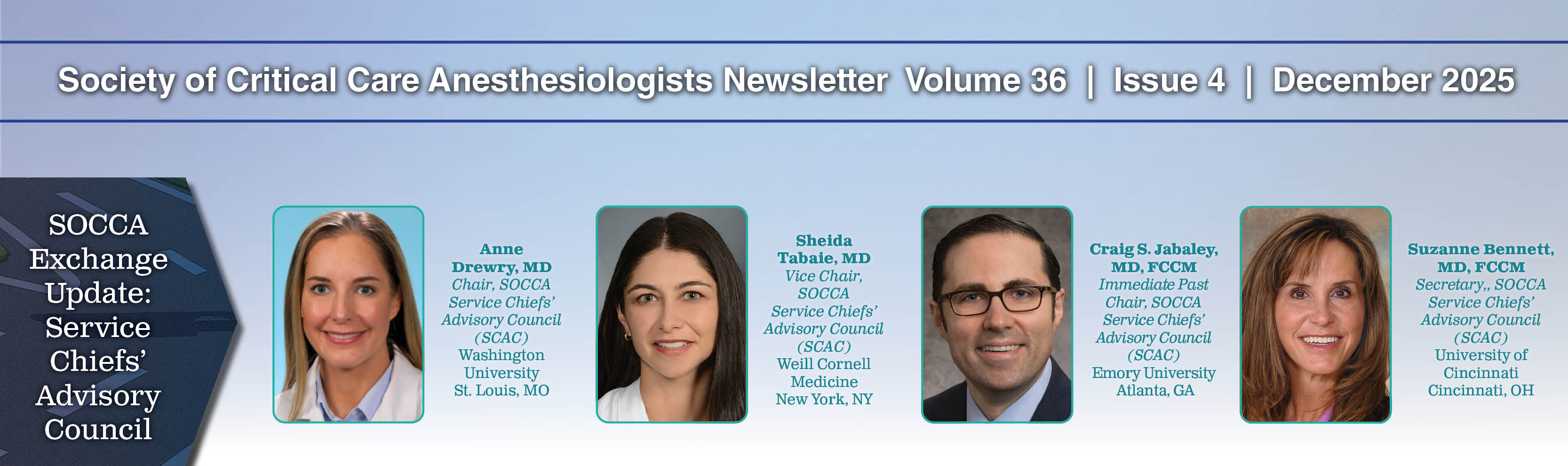
SOCCA Exchange Update: Service Chiefs’ Advisory Councilby Anne Drewry, MD Volume 36 | Issue 4 | Dec 2025 The Service Chiefs’ Advisory Council (SCAC) continues to advance its role as a national forum for anesthesiology critical care leaders. SCAC brings together individuals with broad oversight of local anesthesiology critical care practices, creating a unified space to share operational insights, compare organizational models, and better understand the forces shaping our subspecialty. The value of SCAC lies in its ability to provide a national perspective into practice environments, staffing needs, and workforce pressures, elements that directly affect both the stability of existing programs and the attractiveness of the field to future critical care anesthesiologists. SCAC addresses the downstream realities of clinical practice and workforce sustainability that ultimately influence whether trainees view critical care anesthesiology as a desirable career path, complementing the ongoing efforts of the Program Directors’ Advisory Council. The Compensation, FTE, and Staffing Survey is now in its final stages of revision. This nationwide, institution-level survey is designed to provide a clearer and more standardized understanding of compensation structures, full-time equivalency definitions, and staffing models across the country. Prior efforts relying on individual respondents limited accuracy and generalizability. By collecting data at the institutional level, SCAC aims to produce a robust and representative national picture of contemporary and future practice environments to be shared amongst the SOCCA membership. A test run of the survey is planned prior to full rollout to ensure clarity and ease of completion. Please reach out if interested in testing the survey. Recruitment challenges remain common across institutions, and the forthcoming survey is expected to illuminate variations in practice structures nationwide. Aligning with the theme of this issue of the Interchange, this work will also help identify opportunities within subspecialty programs, like those in which mechanical circulatory support and cardiothoracic critical care comprise the primary clinical coverage, by clarifying how these high-acuity service lines are organized, staffed, and supported across institutions. This data will support more informed workforce planning and may clarify which elements of practice structure most strongly influence the desirability of a career in critical care anesthesiology. Work continues with the SOCCA office to integrate the SCAC directory into MemberClicks to improve accuracy and accessibility. SCAC has transitioned to a quarterly meeting schedule to maintain consistent progress on these and other identified future initiatives. Over this past year, leadership transitions within SCAC have been completed. Dr. Anne Drewry now serves as Chair, with Dr. Sheida Tabaie as Vice Chair. Dr. Suzanne Bennett has joined the leadership team as Secretary. Dr. Craig Jabaley continues to support the Council as Immediate Past Chair and is leading efforts to update and streamline the contact directory and finalize the survey. Institutions experiencing leadership transitions are encouraged to share updated contact information to ensure comprehensive national representation. |