Bridging the Gap: Advancing ECMO Education Across Anesthesiology Critical Care Fellowships
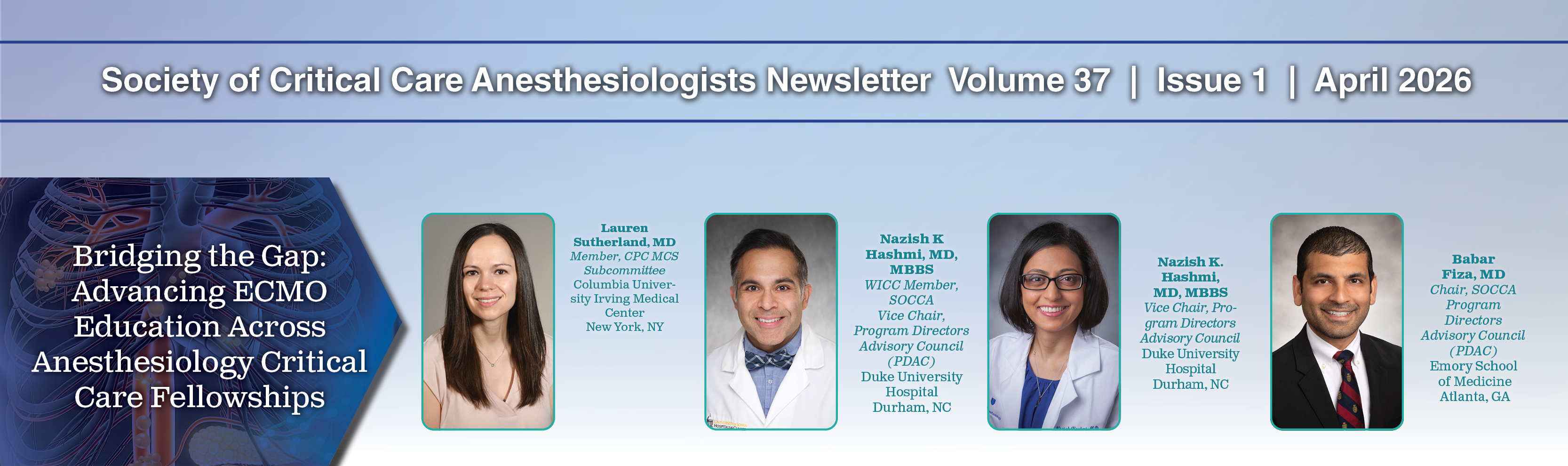
by Lauren Sutherland, MD
Member, CPC MCS Subcommittee
Columbia University Irving Medical Center, New York, NY
&
Lovkesh Arora, MD, FASA, E-AEC
Member, CPC MCS Subcommittee
University of Iowa Hospitals & Clinics, Iowa City, IA
&
Nazish K. Hashmi, MD, MBBS
Vice Chair, Program Directors Advisory Council
Duke University Hospital, Durham, NC
&
Babar Fiza, MD
Chair, Program Directors Advisory Council
Emory School of Medicine, Atlanta, GA
Volume 37 | Issue 1 | April 2026
Over the past decade, extracorporeal membrane oxygenation (ECMO) and other forms of mechanical circulatory support (MCS) have transitioned from rare salvage therapies to essential components of advanced critical care. Since 2010, the use of adult ECMO in North America has grown more than threefold, with over 9,000 reported cases.1 This rapid expansion has reshaped expectations for critical care physicians, who increasingly manage patients supported by both temporary and durable MCS devices. Furthermore, over the past decade, Anesthesiology Critical Care Medicine (ACCM) physicians have expanded their expertise to include not only daily ECMO management but also patient selection, cannulation, weaning, and decannulation decisions — roles once primarily performed by cardiothoracic surgeons.
Managing critically ill patients with MCS demands a nuanced understanding of complex physiology and pharmacology, along with proficiency in handling hemodynamics, anticoagulation, mechanical ventilation, and device integration. Clinicians trained through the ACCM pathway bring a unique background in perioperative physiology, hemodynamic management, and interdisciplinary coordination, making them especially well-equipped for this role.
Current Gaps
As the clinical demand for ECMO expertise continues to expand, fellowship training has not uniformly kept pace with this growth. A 2018 survey by Cook et al.² found that while most critical care fellowship program directors recognized ECMO management as an increasingly essential skill, only one-third believed their graduating fellows were competent in its management, and even fewer felt their trainees could perform cannulation. Training opportunities often depend on local case volume, institutional resources, and faculty expertise rather than shared curricular expectations. While some fellows gain hands-on experience through structured ECMO rotations, others may have primarily didactic or observational exposure. In contrast, cardiothoracic surgery and cardiology trainees follow well-defined ACGME milestones and procedural benchmarks for mechanical circulatory support.3,4 The absence of comparable national standards in ACCM contributes to variability in training experiences and creates challenges for local credentialing and privileging, potentially ceding leadership in this growing clinical domain to other subspecialties. As MCS becomes a cornerstone of cardiopulmonary critical care, the anesthesiology intensive care community must clearly define its professional scope within this space. This paradigm shift highlights the need for a structured, competency-based ECMO curriculum that aligns training with modern clinical practices.
Defining Competency: A Framework for Progress
An initial step forward is the development of shared competencies in MCS that complement existing milestones in ACCM. These competencies should be incorporated into fellowship training to ensure alignment with current clinical practices while allowing flexibility for programs with differing case volumes and institutional models. Three broad, interconnected domains that can serve as the foundation for MCS training may include:
- Medical Knowledge: A comprehensive understanding of device physiology and function; patient selection and timing for MCS initiation; hemodynamic monitoring and interpretation; anticoagulation and hemostasis management; troubleshooting device-specific complications; strategies for weaning and decannulation; and integration with other organ support systems such as renal replacement therapy and mechanical ventilation.
- Procedural and Technical Skills: Proficiency in circuit and oxygenator management; emergency troubleshooting (e.g., air entrainment, flow loss, or hemolysis); and the use of simulation-based and supervised bedside experiences to cultivate both technical proficiency and cognitive readiness for high-stakes scenarios. Depending on local expertise and resource availability, training could also foster familiarity and, where feasible, proficiency in cannulation and decannulation across different MCS configurations, including venoarterial, venovenous, and hybrid.
- Systems-Based and Professional Practice: Leadership in multidisciplinary team coordination; participation in quality improvement and patient safety initiatives; familiarity with institutional protocols and national standards; ethical and communication skills related to goals of care and resource stewardship; and ensuring safe transitions of care across perioperative and ICU settings. Mapping these competencies to measurable milestones and entrustable professional activities would enable programs to assess trainee readiness systematically, promote transparency in credentialing and privileging, and align fellowship training with emerging national standards in mechanical circulatory support.
Working Towards Consensus and Standardization
To translate these ideas into working realities, a coordinated and collaborative effort is essential. A SOCCA-led Mechanical Circulatory Support working group, composed of experts from the Clinical Practice Committee, in partnership with the Program Directors Advisory Council, could develop consensus-based ECMO and MCS competency guidelines for ACCM fellowship programs.
This initiative parallels earlier efforts, such as the 2015 development of Ultrasound Learning Goals for American Anesthesiology Critical Care Trainees, which laid the foundation for structured ultrasound competency within ACCM.5 A similar framework for MCS would advance the specialty’s commitment to standardized, high-quality training and equitable credentialing across institutions.
References
-
Barbaro RP, et al. Extracorporeal Life Support Organization Registry International Report 2023. ASAIO J. 2024;70(3):e15–e30.
-
Cook MR, Badulak J, Çoruh B, Kiraly LN, Zonies D, Cuschieri J, Bulger EM. Fellowship training in extracorporeal life support: Characterization and educational needs assessment. J Crit Care
-
Accreditation Council for Graduate Medical Education (ACGME). ACGME Program Requirements for Graduate Medical Education in Advanced Heart Failure and Transplant Cardiology. Revision effective September 3 2025. Chicago, IL: Accreditation Council for Graduate Medical Education; 2025. Available at: https://www.acgme.org/globalassets/pfassets/programrequirements/2025-reformatted-requirements/159_advancedheartfailuretransplantcardiology_2025_reformatted.pdf. Accessed November 12 2025.
-
Accreditation Council for Graduate Medical Education. ACGME Program Requirements for Graduate Medical Education in Adult Congenital Heart Disease: Review and Comment. Chicago, IL: ACGME; 2023. Available at: https://prod.acgme.org/globalassets/pfassets/reviewandcomment/rc/153_adultcongenitalheartdisease_rc_012023.pdf. Accessed November 12, 2025.
-
Fagley RE, Haney MF, Beraud AS, Comfere T, Kohl BA, Merkel MJ, Pustavoitau A, von Homeyer P, Wagner CE, Wall MH. Critical Care Basic Ultrasound Learning Goals for American Anesthesiology Critical Care Trainees: Recommendations from an Expert Group. Anesth Analg. 2015 May;120(5):1041-1053. doi: 10.1213/ANE.0000000000000652. PMID: 25899271.
|